One of the hardest parts of recovering from a disaster is getting the help you need when you need it. In the beginning, exhaustion, grief, and stress can make it hard to focus on anything, and the last thing you want to face is insurance paperwork or financial assistance applications. That’s where the Federal Emergency Management Agency, better known as FEMA, is supposed to help.
Created in 1979 to coordinate the nation’s response to disasters, FEMA became the central hub for federal recovery assistance after major storms, earthquakes, wildfires, tornadoes, and other emergencies.
While FEMA should bridge the gap between immediate survival and long-term recovery, emergency experts worry that changes in federal disaster policy, staffing reductions, the loss of experienced professionals, funding delays, increasing politicization of disaster relief, and proposed reforms affect the agency’s ability to respond effectively to large disasters.
Survivors can still apply for assistance online, through the FEMA mobile app, by phone, or in person at a Disaster Recovery Center (DRC). FEMA also provides an online DRC Locator tool to help people find nearby recovery centers.
But for many survivors, the process remains difficult. People without reliable internet, phone access, or transportation may struggle to complete applications or travel to recovery centers. Even those with access face long wait times on FEMA’s helpline and struggle to navigate confusing paperwork about eligibility and benefits.
Adding to the already challenging application process, delays in disaster funding, reductions in preparedness programs, and ongoing debates about FEMA’s future role create uncertainty about how quickly aid will reach communities after future disasters. At the same time, FEMA has had to reduce housing support in communities already struggling with housing shortages.
If you are a survivor of a disaster and hope to turn to FEMA, you should prepare for a recovery process that requires persistence, documentation, and self-advocacy. This program, which should be a safety net to make a very insecure time feel a little safer, may not provide the support you need. Many states, however, are beginning to step in more aggressively where FEMA support has slowed or become delayed. But that support is uneven, and most states still cannot fully replace what FEMA historically provided.
What Support Does FEMA Provide?
Many people think of FEMA as an agency that will fully rebuild a destroyed house or write a check large enough to replace everything they lost. In reality, FEMA plays a limited role. The agency provides emergency support only and helps families stabilize after a disaster, not restore a home to pre-disaster condition.
Depending on your financial situation and available funding from FEMA, you may qualify for a range of support services and coverage for certain disaster-related expenses that your insurance does not cover. Assistance may include:
- Temporary lodging (if your home is unsafe or uninhabitable)
- Rental support
- Home repairs to make a damaged structure safe and functional
- Cleaning and sanitizing your home to prevent health issues
- Personal property replacement, including furniture, computing devices, and basic appliances
- Replacement of disaster-damaged work tools, if you’re self-employed
- Disaster-related expenses, such as medical or dental costs not covered by insurance
- Funeral expenses
Who Is Eligible for FEMA Support?
FEMA supports U.S. citizens, non-citizen nationals, or qualified permanent residents. Its Individual Assistance Program is time-limited and is only available in “presidentially declared disaster areas.”
FEMA generally requires you to verify your status with a valid Social Security number when you apply. You’ll also need proof of occupancy, ownership, insurance information, and verification that the federally declared disaster caused the damage.
Inspectors may visit your property, and you may need to submit additional paperwork or appeal decisions. FEMA places caps on assistance, since it is only intended to supplement insurance rather than replace it.
How Can You Apply for Support?
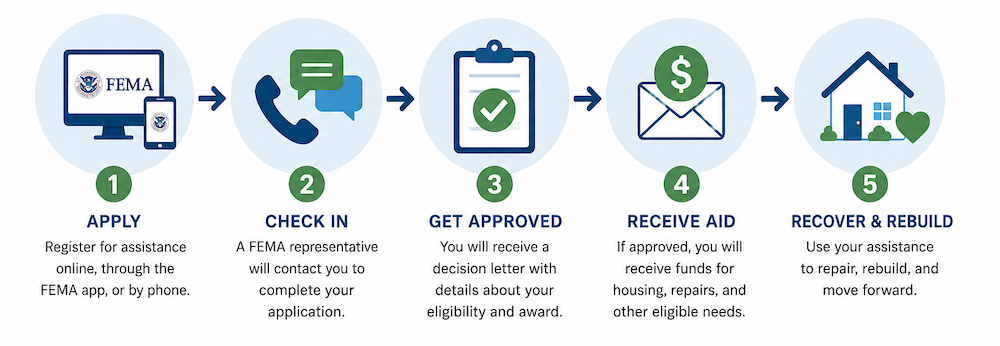
Once a declaration of disaster is in place, you can apply for support online at https://www.disasterassistance.gov, download the FEMA app from the Apple Store or Google Play, or call 1-800-621-FEMA. Once you’re in the system, you can track your application and learn what documentation you need to submit. If you have homeowners or rental insurance, you don’t need to wait for your insurance company to provide a final settlement before you apply. However, FEMA requires you to file a claim with your insurance provider and requires a benefits letter or denial before approving any unmet needs that your insurance company doesn’t cover.
States Try to Fill the Gap in Disaster Response
In some parts of the country, states are beginning to expand their own disaster recovery programs as FEMA funding slows and federal policy shifts create uncertainty. But states face major challenges as they try to take on even part of FEMA’s role because they lack the buying power of the federal government while also coping with declining tax revenues and cuts to additional federal support programs.
It’s important to note that states vary enormously in resources, staffing, and budget flexibility. Wealthier states, such as California, Massachusetts, North Carolina, and Minnesota, have created or expanded state disaster reserve accounts to prepare for future shortfalls in federal recovery funding. But smaller disaster-prone states could struggle to absorb larger recovery costs if federal support continues shrinking. Many governors are very publicly requesting additional FEMA assistance.
If FEMA delays, denies, or provides too little assistance, do not assume your recovery options end there. State emergency agencies, county recovery offices, local housing authorities, and nonprofit organizations may offer additional programs that fill gaps federal aid does not cover. Disaster recovery is rarely a straight path, and persistence can make a meaningful difference as you zig and zag through the process to find the right support.