
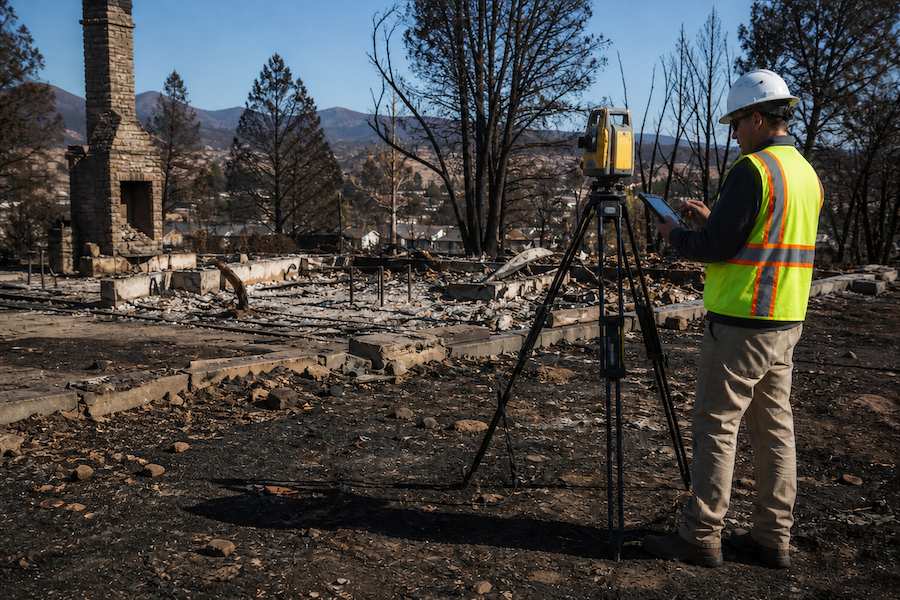
You might think that once you’ve had a property assessment done and know the land is safe to build on, you’re ready to get your new home designed and apply for a building permit. But, there’s still another task to consider—whether you need site reports. These reports record the condition, boundaries, and stability of your property and provide the clarity and confidence you need to guide design and construction.
Depending on the extent of the damage, your building designer, contractor, and building department may require several different site reports, reviewed below. In most cases, these reports are considered part of the rebuilding process, so you should include their cost in your insurance claim.
Boundary Survey
Fires, floods, earthquakes, and major storms can destroy or shift the markers or monuments used to define your lot. Before you have new foundations poured, you’ll need to clearly reestablish those boundaries. In some cases, common markers, such as fences, may remain. Be aware, however, that they may not be reliable markers for your exact property lines.
If all property line markers have been lost, you and your neighbors may need to hire a licensed land surveyor. The surveyor will retrace the original survey as closely as possible. However, if there were errors in the original survey, you may not be able to rely on old lines. You’ll need to use local land survey laws to resolve any discrepancies. If you and your neighbors can’t agree, a real estate attorney can help resolve disputes and prevent a prolonged conflict.
A Topographical Survey
In severe situations, when a storm or fire damages or destroys foundations or retaining walls, you may need a topographical survey. This report maps the elevation and layout of your property, including slopes, drainage patterns, and existing features. Many cities require a survey before issuing a building permit.
Your architect will use this topographical survey as a guide in preparing the building and site plans. The survey will ensure that the house they design works with the land rather than against it.
Geotechnical Engineering Reports (Soil Reports)
In addition to whatever testing you may have done during your property assessment, you may need a soils report when you file a building permit application. This tests for things like soil compaction, stability, and potential contamination. It also provides recommendations for foundation type, such as spread footings or drilled piers. A soil report gives your designer the technical information needed to complete a stable and secure foundation design. The geotechnical engineer often monitors foundation construction and includes their findings in the final report.
If you had construction done on your property before the disaster, it’s possible the contractor ordered a soils report. Check with your local building department to see if they have this on record.
Changes in Infrastructure
Depending on where you live and the nature of the disaster, your city or county may decide to make infrastructure improvements, such as widening streets for better emergency access. If your property is along one of these streets, you’ll need to confirm any new setback requirements before beginning your building plans.
Additionally, your utility company may decide to move power lines or other utilities underground. If they do, you’ll need access to accurate maps showing the location, depth, and path of these lines.
In some cases, small surface markers—such as metal plaques, paint markings, or stakes—will indicate where lines run. In others, the Geographic Information Systems (GIS) may document utility infrastructure digitally. GIS technology maps allow utility companies and homeowners to view the location of underground lines via an interactive online platform.
Bringing It All Together
While site reports may not be the most visible part of your rebuild, they are one of the most important. Think of them as the blueprint beneath the blueprint—ensuring that everything you rebuild is safe, compliant, and built to last. They are the last step before you’re ready to start the design and build process.